It travelled through cardboard and courier vans into a city stilled by fear. Streets emptied. Churches fell silent. Death counts scrolled across screens like an unending litany. The air itself carried suspicion. Breath had become fragile currency.
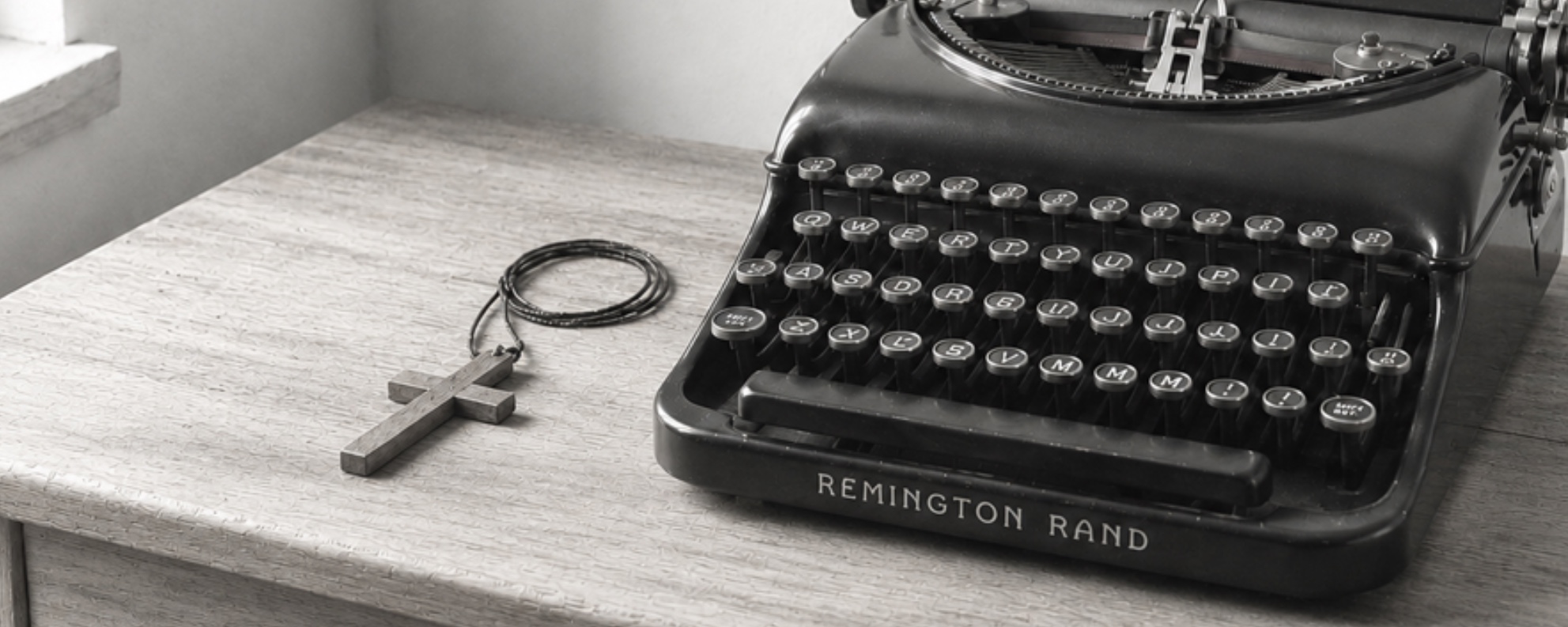
Inside the box lay a Remington 5: black, heavy, unembarrassed by its age. A machine built for endurance, for offices where paper mattered, where words had consequence, where communication moved at the speed of human intention rather than electricity.
It smelled faintly of dust and old rooms.
The case held a small paper tag, browned and frayed, tied with string that had outlived governments. On it, in a steady hand:
Mr Edwin Mercer
Strathallan & Co.
17 Calton Crescent
Edinburgh
A record of repair.
A promise of return.
A moment suspended.
Europe was tearing itself apart. Cities burned. Borders shifted. Young men vanished into uniforms. Letters carried news that shattered households. In that world, a typewriter could become collateral — an ordinary casualty of extraordinary times.
The question that gripped me was simple.
Why did it wait?
Through air raids and ration books. Through victory parades and reconstruction. Through the slow reshaping of Britain’s identity. Through television, satellites, computers, the internet. Through the dismantling of the industrial world that produced it.
The shop closed. Dust settled. Owners died. Generations turned over like pages.
Still it remained.
A machine designed for words kept silent longer than many human lives.
I began to look for the man whose name was written on the tag. It felt less like curiosity and more like obligation, as though possession of the object carried responsibility toward the life attached to it. History often protects its secrets. Records ended. Trails dissolved. The man remained absent, like a voice speaking from another room whose door stayed closed.
Years passed.
Then, in 2025, I searched again and found him immediately. An obituary. Recent. Clear. Undeniable. The details aligned: the address, the profession, the timeline, the thread of a life that made sense of the tag.
He had been alive all along.
While this machine sat unseen in an old repair shop, he had lived through the rebuilding of Europe, the reshaping of the twentieth century, the rise of the modern world. He married, worked, aged, endured, and finally died, as far as I can tell unaware that a piece of his past still existed, bearing his name like a quiet testimony.
There is a theological violence in that realisation.
We imagine history as something finished, archived, settled. Yet the past leaks into the present constantly, refusing burial. Objects become witnesses. Matter remembers what human memory releases.
Scripture speaks of stones crying out, of blood speaking from the ground, of creation groaning. We often domesticate such language, making it poetic rather than dangerous. Yet here was steel and paper insisting that a human story had continued beneath the surface.
This typewriter was a fragment of an unfinished sentence.
I sometimes imagine the day he carried it into the repair shop. Perhaps he expected to collect it the following week. Perhaps he intended to resume work, correspondence, ordinary rhythms. Then the machinery of war accelerated, swallowing individual plans whole. Personal history bent under global catastrophe.
No one chooses the moment history interrupts their life.
Pandemic taught us that again.
In 2020, I unwrapped a machine abandoned during one world crisis while living through another. Death counts then. Death counts now. Fear then. Fear now. Isolation then. Isolation now. Human beings discovering again how fragile our arrangements truly are.
And still, the machine survived both.
Overlooked. Stored away. Preserved through obscurity.
There is something profoundly theological about that.
God’s work often unfolds in what appears forgotten. The overlooked becomes the site of revelation. A child in a manger. A crucified body outside the city walls. A tomb mistaken for finality. The sacred appearing where attention has already moved on.
Now the Remington sits on my desk, its keys striking paper with uncompromising force. Each letter lands like a footstep across time. Words emerge through a mechanism older than most of the systems surrounding it.
It does what it was made to do.
And in doing so, it bears witness to a man whose life spanned one of the most turbulent centuries in modern history — a life now concluded, yet still speaking through steel and ribbon.
The machine waited longer than he lived.
Perhaps that is the most unsettling truth of all: the world kept his memory in material form long after he had ceased to carry it himself.
We often place memory inside the mind. Scripture places memory in covenant, in land, in bodies, in scars, in bread, in wine, in water, in stones, in rituals that refuse to let the past dissolve.
This Remington exposes how thin the boundary is between presence and absence, between what is lost and what waits to be found.
It arrived during a season when humanity confronted its vulnerability, as though history had folded in on itself. A machine abandoned in one era of global upheaval reappeared in another, insisting that time moves with more mystery than our calendars admit.
Sometimes the past walks toward us.
Sometimes it arrives at the door, wrapped in cardboard, carrying a name written by someone long gone, asking whether anyone is still willing to listen.
And when the keys strike the page in the quiet of evening, the sound is more than memory.
It is defiant.